


A utility locator quotation is only useful when the buyer knows what the package can do on the intended job. A receiver, a transmitter kit, and a system that also records survey positions solve different purchasing problems, even when the listings use similar product names.
For contractors comparing Radiodetection equipment from UCG Underground, the starting point should be configuration: which receiver variant is included, how the crew will apply a signal, and what evidence the customer expects after the location.
The 2026 market offers choices across detection, signal application, and digital recording. This review uses published equipment information and a dated US price list to explain those choices. Its focus is the equipment and purchasing decisions a contractor can verify.
What the 2026 equipment market actually offers
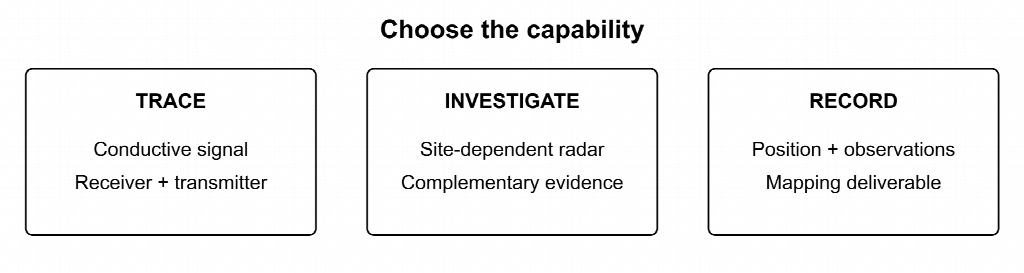
Equipment belongs in three purchasing categories.
Electromagnetic cable and pipe locating systems trace a usable signal on a conductor. Their practical scope depends on access, continuity, and signal application. The receiver alone does not create the active signal needed for a controlled trace.
Ground-penetrating radar provides another way to investigate the subsurface, including targets without a usable conductive path. Its effectiveness varies with the site. USDA guidance identifies increasing soil conductivity from water, clay, and soluble salts as an important restriction on radar penetration.
Mapping-enabled systems add a record of the operator’s surface position and locate observations. Radiodetection’s RD8200SG combines utility locating with GNSS RTK positioning. That is a different deliverable from simply marking a route.
These categories can complement one another. Buying one does not eliminate the operating limits of the others.
A price snapshot with the package boundaries visible
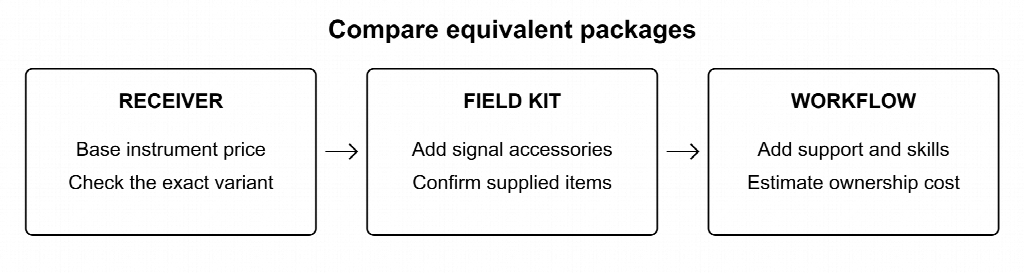
Radiodetection’s USA Price List, 2026 Issue 1, provides the following reference points. Figures are published list prices in US dollars, reviewed in September 2026. They are not negotiated quotes, used-equipment values or averages for the whole market.
| Listed configuration | Published list price | Comparison boundary |
| RD7200 cable and pipe receiver | $3,152 | Receiver, not a complete active locating kit |
| RD8200 cable and pipe receiver | $5,608 | Transmitter and job-specific accessories must be checked separately |
| RD8200G receiver with usage logging and GPS | $6,333 | Different receiver variant; GPS capability is part of the comparison |
| RD8200SG locator package | $9,524 | Listed with USB-C lead, rechargeable battery pack and mains charger; not a receiver-and-transmitter field kit |
The first procurement lesson is straightforward: a receiver-only price cannot establish the budget for a crew-ready system. Ask for an itemized package before comparing totals.
The second is that a higher-priced variant needs a reason. If the contract requires a mapped record, positioning and data handling deserve evaluation. If the work requires marking and documenting a short service route, a mapping premium should be justified by the actual deliverable.
Technology worth paying for—and what it cannot prove
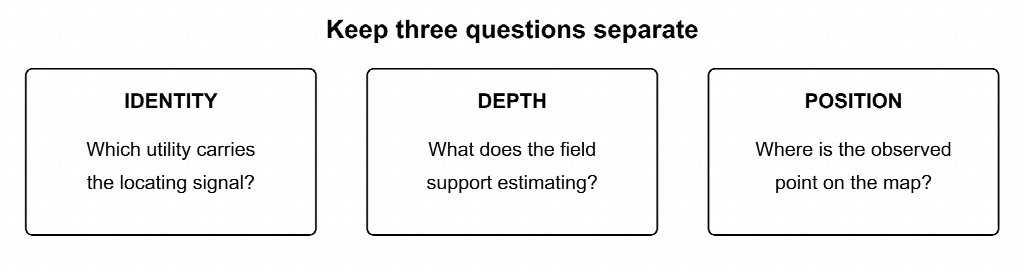
Two separate questions often get folded into an “accuracy” claim: where the recorded point lies on the map, and whether the buried target has been identified correctly.
RTK positioning addresses the first question. It cannot correct a trace that followed another conductor. A precise surface coordinate can still be attached to an uncertain utility observation.
Depth deserves the same separation. The RD8200 manual describes a calculated depth to the target’s center. It warns against using that readout to set mechanical excavation depth. A purchase demonstration should therefore test repeatability against a known target, not merely show a stable number on the screen.
A useful review of Radiodetection depth-testing conditions explains why receiver model, transmitter, frequency, application method, and test geometry belong in the record. Buyers should require those details during acceptance checks.
The practical direction of product development is visible in combined locating and mapping systems. That is evidence of available functionality, rather than proof that every US contractor is adopting it or that mapping upgrades automatically improve buried-line accuracy.
Procurement priorities beyond the purchase price
The useful purchasing unit is a functioning workflow: apply the signal, trace the route, evaluate uncertainty, record the result, and arrange further verification when required.
Budget discussions should include training, accessory replacement, service arrangements, and time spent on difficult sites. These are proposed procurement categories, not fixed cost percentages; each contractor should estimate them from its own workload.
The consequences of a failed locate also need careful accounting. The analysis of underground utility strike costs in the United States separates repair from wider disruption and societal costs. A national estimate should not be inserted into a spreadsheet as the expected invoice for each strike.
For a contractor, a better starting point is its own evidence: repair exposure, project interruption, repeated visits and unavailable equipment. A more expensive kit can be defensible when it solves a recurring constraint. It cannot be justified simply by multiplying an advertised performance claim by a generic damage-cost figure.
How to compare quotes without buying the wrong package
Send every supplier the same scope and ask for the following:
- Full receiver and transmitter model names, including suffixes.
- Connection leads, ground accessories, clamps, power supplies, and carrying equipment included in the price.
- Supported frequencies for the exact receiver, transmitter, and accessories.
- Service history and an acceptance test for used equipment.
- Warranty terms, return conditions, and the proposed support route.
- Mapping software, correction services, or other dependencies where the deliverable requires them.
Accessory compatibility should be explicit. Radiodetection distinguishes transmitter clamps from receiver clamps; physical resemblance does not make their function interchangeable. A clamp that fits around the cable still needs to match the intended transmitter and application.
Treat digital capability as an end-to-end question. Who receives the exported data? Which fields does the customer need? Who checks uncertain points? These questions expose a purchasing mismatch earlier than a feature comparison alone.
A practical buying decision
Start with the work mix and identify the limitation that most often stops the crew. It may be inadequate signal access, incompatible accessories, uncertain interpretation, or a missing mapping deliverable.
Then compare complete, equivalent configurations and test them on a representative target. Price matters, but it becomes meaningful only after package scope and operating limits are visible.
For 2026 procurement, a defensible decision is a documented fit between the job, the crew, and the equipment. Published prices establish reference points; field acceptance and a clear scope establish whether a particular purchase is useful.