
Forty-three seconds. That’s roughly how long it takes someone on the other end of a video call to form a first impression of your space. Not of you. Of your room. And if what’s behind you is a pile of laundry, a blank beige wall, or a flickering overhead bulb, that impression sticks.
Styling a home office for video calls is a different challenge from styling a room you just want to look good in. You’re working with a fixed frame, a camera angle that cuts off everything below your shoulders, and lighting conditions that change by hour and season. Get it right, though, and your background quietly tells clients and colleagues that you’re organized, intentional, and worth taking seriously. This piece gives you a repeatable system and the specific choices that make it click.
The FRAME Framework for a Camera-Ready Home Office
There’s a reliable way to think through any home office styling job, and it breaks into five components: Focal point, Rear-wall styling, Anchor furniture, Materials, and Edges. Call it the FRAME Framework. It keeps you from making the classic mistake of decorating the whole room when the camera only sees about six square feet of it.
Focal point is whatever sits directly behind your head in the camera frame. One shelf of curated objects, a piece of art, or a textured wall treatment is all you need. Nothing symmetrical, nothing too busy. Two to four items at different heights reads instantly as “styled.” Ten items reads as clutter.
Rear-wall styling is the zone surrounding that focal point. Neutral paint performs better than wallpaper on camera because busy patterns compress into visual noise at lower resolutions. Warm whites and mid-tone greiges hold the most detail.
Anchor furniture is the piece that gives the room structure. In most home offices, this is the desk. Its material, profile, and finish set the visual tone for everything else. A heavy wood-and-metal piece signals permanence. A flimsy particleboard table signals the opposite.
Materials is the mix rule: keep two or three material families in the frame maximum. Wood, metal, and a soft textile works. Adding glass, acrylic, and ceramic into the same shot creates visual competition.
Edges is the frame itself. What enters from the left and right edges of the camera matters more than most people realize. A plant, a lamp, or a bookend object at the periphery gives the shot a composed feel. A door frame or a bare wall corner does nothing for you.
Choosing the Right Desk as Your Anchor Piece
Take Dana, a freelance brand strategist who works almost entirely on video. Her old desk was a white laminate rectangle she picked up years ago. It photographed like an office supply catalog. When she swapped it for a metal-framed industrial piece with a wood-grain top, her clients started commenting on her setup unprompted. Nothing else changed. The desk did the heavy lifting.
The desk is the single most visible piece of furniture in a home office shot because the camera sits at desk height. That position means the desk edge, the surface, and the legs are all in frame simultaneously. A piece with visual weight, real materials, and a defined style reads as considered. A flat, featureless surface reads as nothing.
Industrial-style desks, specifically those that pair black powder-coated metal pipe frames with wood surfaces, have become the strongest performer in this context because the contrast between materials is visible even at low resolution. The dark metal frames punch through a bright background. The wood grain adds warmth without going soft. Pipe desks from makers who build in the US with reclaimed wood panels take that visual logic further, since the aged texture of salvaged wood holds detail in camera in a way that fresh-milled surfaces simply don’t.
According to the Bureau of Labor Statistics’ American Time Use Survey, 35% of employed Americans did some or all of their work remotely in 2025, up from 33% the year before , as reported by CNBC in July 2026. That’s tens of millions of people whose work credibility now lives partly in how their home office reads on screen. The desk they sit at is not a décor choice. It’s a professional signal.
What to Put Behind You and What to Ditch
The rear wall is where most people go wrong. They either leave it completely bare, which reads flat and low-effort on camera, or they pack it with everything they own, which reads chaotic. The sweet spot is density with intention.
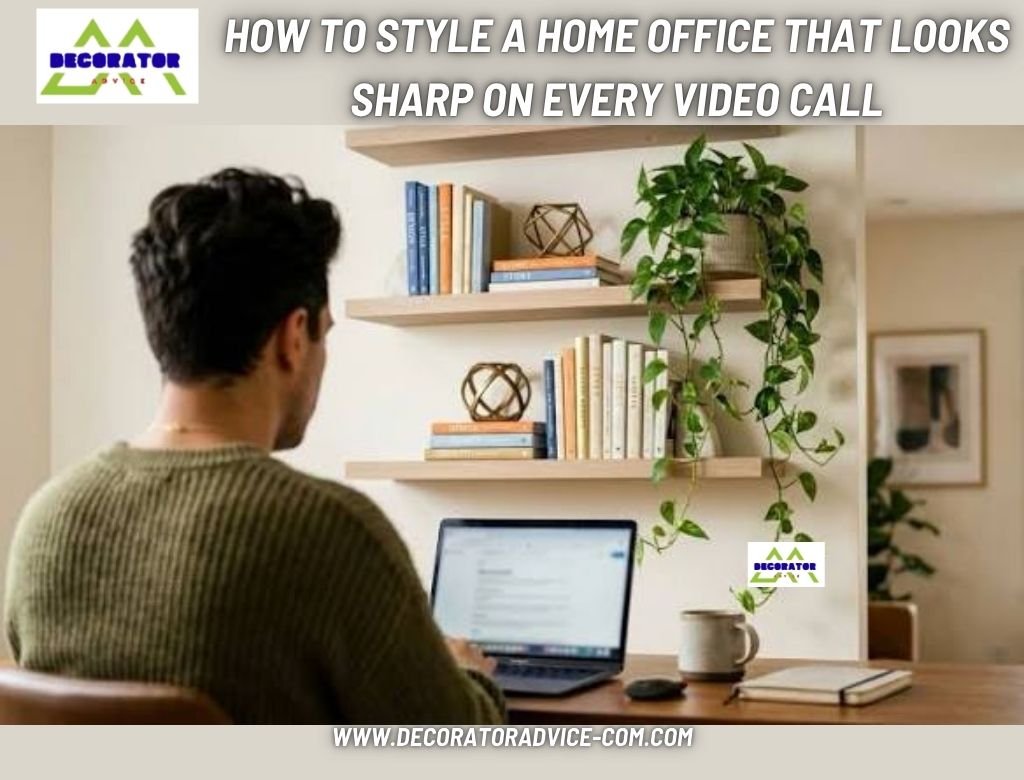
A floating shelf installed at eye-level behind the monitor is the highest-return styling move in a home office. Three to five objects at varied heights, grouped loosely rather than lined up rigidly, gives the camera something interesting to rest on. A small plant, a framed print, a ceramic piece, and one or two books with interesting spines. You don’t need to go further than that.
What to remove: anything with text that the camera might accidentally zoom in on, anything reflective that will catch your ring light, and anything the color of your skin tone, since those objects tend to blur into the background of the shot and disappear entirely.
“The background you set in a video call functions the same way a personal brand element does. It communicates values before you say a word. Structured, curated, warm environments correlate with perceived credibility in professional contexts.” This reflects the consensus from researchers studying professional identity cues in remote communication environments.
Lighting: The Element That Overrides Everything Else
You could have the best-styled office on the planet and still look washed out, shadowy, or orange if the lighting is wrong. Lighting quality matters more to camera output than any physical object in the room.
The basic rule is this: your primary light source should face you, not sit behind you or above you. A window behind you creates silhouette. Overhead fluorescents create shadows under your eyes and nose that read on camera as harsh. A light positioned in front of you at slight elevation gives the camera what it needs: an evenly lit face with a flattering fill.
| Light Type | Camera Result | Best Use Case |
| Natural window light (behind you) | Silhouette, dark face | Avoid for video calls |
| Natural window light (facing you) | Soft, flattering | Best option if available |
| Overhead fluorescent | Harsh shadows, cool tone | Only as ambient fill |
| Ring light or LED panel (front) | Even, warm fill | Primary light source |
| Desk lamp angled upward | Warm mood, slight fill | Good edge or accent light |
For your background, research suggests that recycling and reusing wood materials can reduce carbon emissions substantially , per analysis from Superior Hardwoods, and that sustainability angle matters here because reclaimed wood finishes also age in ways that synthetic surfaces don’t. Those subtle variations in grain and tone look richer on camera than uniform manufactured surfaces. A bookshelf or accent panel in reclaimed wood behind your desk earns its place twice: once for style, once for environmental intention.
A Practical Checklist Before Your Next Call
Run through this before you go live. It takes under two minutes and catches most of the common problems.
- Open your camera app and look at the frame cold, the way a stranger would see it.
- Check that your light source is in front of you, not behind.
- Count the objects visible on your rear wall. If you can count more than seven distinct items, remove some.
- Scan for unintentional text or logos in the background that you wouldn’t want visible during a client call.
- Check that your desk surface is clear except for what you actually need during the call.
- If your background has a mix of warm and cool light sources, pick one color temperature and stick to it.
- Tilt your monitor slightly to adjust your eye line. Looking slightly down at the camera is more flattering than looking up.
None of this requires a renovation or a big budget. Most of it is arrangement and subtraction. The anchor furniture choice is the one decision with long-term payoff, because a well-made desk stays in a room for years and keeps paying visual dividends on every single call you take from it.
Your home office is not just where you work. It’s the first room that every remote colleague and client ever sees. Treat it like one wall of a storefront, not like a utility closet with a chair in it. Get the desk right, get the light right, and the rest mostly follows.