

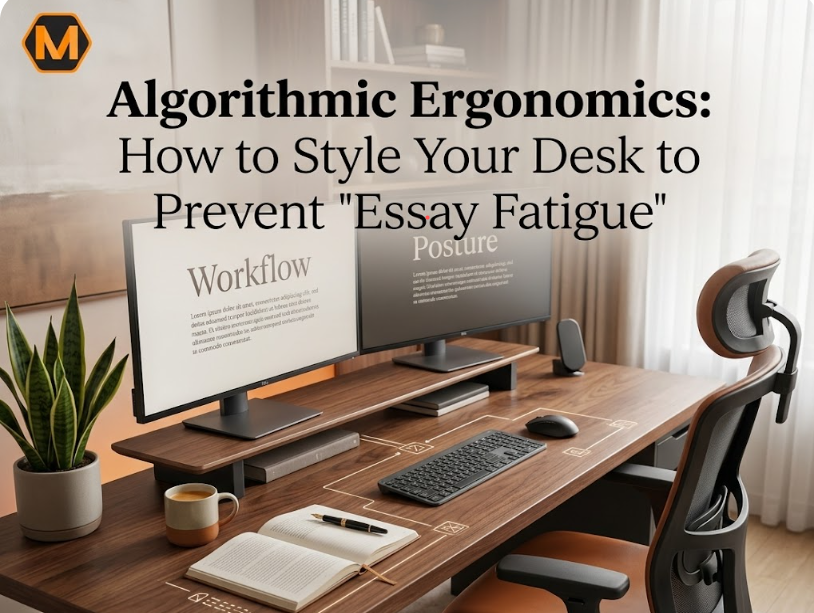
The modern student’s life is often a marathon of digital endurance. We spend hours hunched over keyboards, navigating a sea of tabs while trying to distill complex ideas into coherent arguments. This physical and mental strain has a name: “Essay Fatigue.” It is that specific point where your neck stiffens, your focus blurs, and the words on the screen start to lose their meaning. While most people view desk styling as a purely aesthetic choice, the emerging concept of Algorithmic Ergonomics suggests that the way we organize our physical space can actually optimize our cognitive performance and physical health.
[Diagram: The Golden Triangle of Algorithmic Ergonomics – A visual representation showing the intersection of Physical Alignment (Posture), Cognitive Load (Visual Minimal), and Sensory Input (Lighting/Plants).]
Creating a space that fights fatigue requires more than just a comfortable chair; it requires an intentional layout that manages your body’s energy. When the pressure of a deadline becomes overwhelming, many students realize that environmental optimization is only half the battle. If your workspace is perfectly tuned but your energy is depleted, utilizing a reliable expository essay writing service can be a game-changer. By integrating expert support from myassignmenthelp, you can ensure your academic output remains high-quality while you take the necessary time to recalibrate your physical environment for long-term health.
The Architecture of the Neutral Zone
The core of Algorithmic Ergonomics is the “Neutral Zone.” This is a configuration where your body experiences the least amount of musculoskeletal stress. In a luxury home setting, achieving this doesn’t mean you need a clinical-looking office. A bespoke wooden desk can be paired with a high-back velvet chair that offers hidden lumbar support, blending high-end interior design with medical-grade functionality.
To achieve the Neutral Zone, follow these specific “algorithms” for placement:
- The Monitor Algorithm: Your screen should be exactly an arm’s length away. The top third of the monitor should align with your eye level. This prevents “Text Neck,” a condition where the weight of your head puts 60 lbs of pressure on your cervical spine.
- The 90-Degree Rule: Your elbows, hips, and knees should all maintain a 90-degree angle. This ensures blood flow remains consistent and prevents the “pins and needles” sensation during long research sessions.
- The Desktop Horizon: Keep your most-used items (keyboard, mouse) within a 10-inch “primary zone” to prevent overreaching, which causes shoulder strain.
Reducing Cognitive Load Through Visual Silence
Visual noise is one of the biggest contributors to essay fatigue. Every stray cable, random paper, or mismatched accessory on your desk is a tiny “data point” your brain has to process. By practicing digital and physical minimalism, you free up “bandwidth” for your actual work. Use hidden cable management systems and monochromatic desk organizers to create a sense of visual silence.
This is especially important when you are tackling complex subjects that require deep immersion, such as when you are analyzing various Sociology Research Topics that demand your full attention and critical thinking skills. When the eye can rest on clean, intentional lines, the brain can dedicate more power to synthesizing information rather than filtering out distractions.
Comparison: Standard Setup vs. Algorithmic Styling
| Feature | Standard Student Desk | Algorithmic Luxury Desk |
| Lighting | Single overhead blue-light | Layered (Ambient + Task) |
| Surface | Plastic or cluttered veneer | Natural wood or leather inlay |
| Organization | Open piles of paper | “In-sight” vs. “Out-of-sight” zoning |
| Ergonomics | Static chair, flat desk | Adjustable lumbar, monitor riser |
| Mental State | High stress, high fatigue | Flow state, sustainable energy |
Lighting and Biophilic Optimization
The quality of light in your study sanctuary dictates your circadian rhythm and alertness levels. Avoid the harsh glare of overhead fluorescent lights, which are notorious for causing headaches and eye strain. Instead, opt for layered lighting: a warm ambient lamp for atmosphere and a focused, adjustable task light for your reading area.
To truly elevate the space, incorporate biophilic design. A single, well-placed snake plant or a small terrarium does more than just look premium; it improves air quality and provides a “micro-break” for your eyes when you look away from the screen. Research shows that looking at greenery for just 40 seconds can significantly boost concentration levels. In a 2026 luxury home, this translates to “Living Walls” or marble planters that house oxygen-rich plants like Peace Lilies or Pothos.
The Psychology of Sensory Textures
Luxury is often defined by touch. In a high-performance workspace, sensory-rich textures like a leather desk mat, a linen-bound journal, or a ceramic mug can ground you during high-stress study sessions. These materials provide a tactile contrast to the cold, flat surface of a laptop or tablet.
This “sensory grounding” helps reduce the mental drift that leads to procrastination. When your environment feels intentional and high-end, your work often follows suit, rising to meet the standards of the space you have curated. Think of your desk as a “stage” for your intellectual life; the better the stage is set, the better your performance will be.
Managing the “Academic 10%”: A Holistic Approach
The ultimate goal of Algorithmic Ergonomics is to create a sustainable workflow. However, we must acknowledge that some weeks are simply heavier than others. True productivity isn’t just about working harder; it’s about working smarter. If you have optimized your lighting, corrected your posture, and cleared your desk, yet the sheer volume of research remains daunting, it is wise to delegate.
Integrating academic assistance into your routine isn’t a sign of failure—it’s a management strategy. It allows you to protect the “sanctuary” you’ve built, ensuring that your desk remains a place of creativity rather than a place of burnout. By managing your time effectively and knowing when to seek help, you maintain the integrity of your luxury lifestyle and your mental well-being.
Essential Desk Styling “Algorithms” for 2026
To keep your workspace ahead of the curve and your energy levels high, implement these three modern protocols:
- The Scent Memory Protocol: Use a specific high-end candle (sandalwood or cedar) only when you are working on your most difficult essays. Over time, the scent will act as a psychological trigger, pulling you into a “flow state” within seconds.
- The Digital Minimalist Protocol: Your desk should have a “No-Phone Zone.” Designate a beautiful ceramic tray across the room for your mobile devices. This removes the “phantom vibration” syndrome that breaks your concentration.
- The 20-20-20 Ritual: Every 20 minutes, look at something 20 feet away (like a piece of art on your wall) for 20 seconds. This prevents the eye muscles from locking into a “near-focus” position, which is a primary cause of fatigue.
Conclusion: Your Workspace as an Investment
Your study space is the foundation of your future success. By applying the principles of Algorithmic Ergonomics, you are doing more than just “decorating.” You are engineering an environment that supports your health, fuels your ambition, and reflects your personal style, Algorithmic Ergonomics.
Whether you are navigating the complexities of a thesis or simply trying to get through a heavy week of assignments, your desk should be your greatest ally. Transform your home office from a simple furniture arrangement into a high-performance engine for success. You deserve a space that looks like a luxury showroom but functions like a high-tech lab—a place where your best ideas can finally come to life without the shadow of fatigue.
Frequently Asked Questions
How does desk height affect mental focus?
When a desk is at the incorrect height, your body constantly makes micro-adjustments to stay balanced. This physical strain creates a “background hum” of discomfort that drains your mental energy, leading to faster cognitive exhaustion during long study or work sessions, Algorithmic Ergonomics.
What is the best lighting for reducing eye strain?
The ideal setup uses layered lighting to eliminate harsh shadows and glare. Combining a warm, indirect ambient light with an adjustable task lamp ensures your workspace is bright enough for reading without the blue-light intensity that often causes headaches.
Can interior design really improve academic performance?
Yes. Environmental psychology shows that spaces incorporating natural elements, organized layouts, and ergonomic furniture lower cortisol levels. A calmer nervous system allows for better information retention and more creative problem-solving.
Why is “visual silence” important for productivity?
Visual silence refers to a workspace free from unnecessary clutter and chaotic colors. By minimizing the number of objects your eyes have to track, you reduce your brain’s “peripheral load,” allowing you to stay in a deep flow state for longer periods, Algorithmic Ergonomics.
About The Author
Cooper Robinson is a seasoned interior design strategist and lifestyle consultant who specializes in the intersection of environmental psychology and academic productivity. With an eye for high-end aesthetics and functional luxury, Cooper explores how intentional living spaces can elevate personal performance. He is a frequent contributor to MyAssignmentHelp, where he shares insights on balancing a curated home life with the rigors of modern scholarly excellence.