

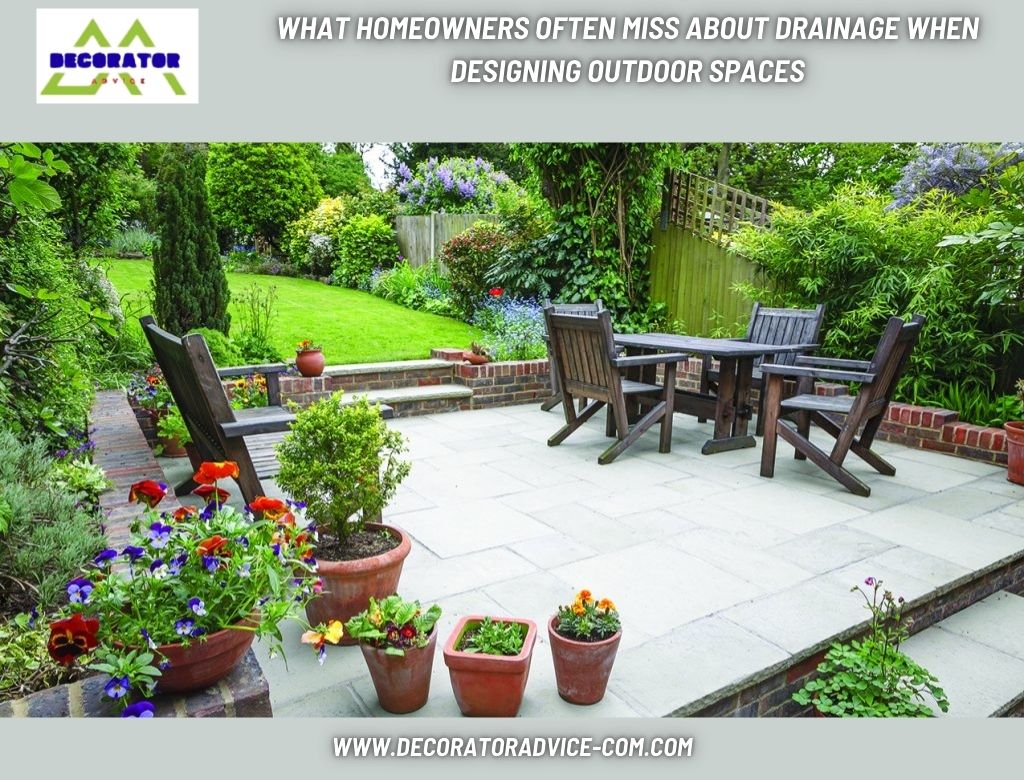
Most homeowners focus on visual elements when planning outdoor spaces. Patios, garden beds, retaining walls, outdoor kitchens, and decorative hardscape usually receive the most attention during the design process. Drainage, however, is often treated as a hidden utility rather than a central part of how the space functions.
This is one of the most common mistakes in residential landscape design across the United States. Water movement affects nearly every outdoor surface and structural element on a property. If drainage is not planned correctly from the beginning, problems often appear long after the project is completed.
In many cases, the outdoor space itself is not poorly designed visually. The issue is that the site was never engineered to manage how rainwater interacts with the landscape once surfaces, elevation, and soil conditions are altered.
Outdoor Design Changes How Water Moves Across a Property
Many homeowners first notice drainage problems after completing a major outdoor upgrade. A newly installed patio may begin holding water after storms, or runoff may suddenly collect near a fence line that previously stayed dry. In many cases, the issue is not excessive rainfall. The property’s drainage behavior changed once new surfaces and elevation adjustments were introduced.
Every outdoor renovation alters how water is absorbed, redirected, or retained across the site. Adding pavers, concrete surfaces, retaining walls, planting beds, or artificial turf changes the hydraulic behavior of the property in Outdoor Spaces.
Before development, rainwater may naturally infiltrate open soil. Once impermeable surfaces are added, runoff increases and begins moving toward lower elevation areas with greater force and concentration.
A patio extension, for example, may appear isolated from the rest of the property, but it can redirect runoff toward foundations, neighboring lots, or landscaped zones that were never intended to hold water. Even relatively small elevation changes can significantly alter drainage patterns.
Why Surface Slope Matters More Than Most Homeowners Realize
One of the most important elements in outdoor drainage is surface grading. A proper slope allows water to move away from structures and prevents pooling on walking surfaces.
Many homeowners assume a flat patio or walkway is ideal because it looks visually clean. In practice, completely level hardscape surfaces often trap water instead of directing it toward collection points.
Professional outdoor construction typically incorporates subtle grading angles that are almost invisible to the eye but essential for drainage performance.
This becomes especially important in regions with frequent seasonal rainfall, including many southeastern U.S. states, where outdoor surfaces may experience repeated saturation over long periods. In these environments, even minor grading errors can lead to persistent standing water and accelerated surface wear.
Without proper slope:
- Water remains on the surface longer after rainfall
- Paver joints weaken due to repeated saturation
- slippery conditions develop on walkways and pool decks
- Runoff begins collecting near structural edges and foundations
These issues usually emerge gradually, which is why drainage failures are often mistaken for material defects rather than grading problems.
Landscaping Can Accidentally Trap Water
Homeowners frequently think of landscaping as separate from drainage infrastructure, but plant placement and soil elevation directly influence how water behaves.
Raised planting beds, decorative borders, and dense vegetation can unintentionally block natural runoff pathways. In some yards, landscaping projects create contained low points where water accumulates after storms.
Mulch also plays a role. While it helps regulate soil temperature and moisture, excessive mulch buildup can obstruct drainage flow near collection points and increase water retention around structures.
Tree roots create another overlooked issue. As roots expand, they can shift soil grades, disrupt underground drainage systems, and alter how water moves beneath the surface.
These effects are rarely immediate. They develop over several seasons, especially in regions with repeated rainfall cycles and expansive soils.
Hardscape Materials Affect Drainage Performance
The material used in outdoor construction influences both runoff volume and water absorption behavior. This is often overlooked when homeowners select materials based primarily on appearance.
Concrete, natural stone, porcelain pavers, gravel systems, and permeable pavers all interact with water differently. Some materials allow partial infiltration, while others accelerate runoff by forcing water to remain entirely at the surface level.
Material texture also matters. Smooth surfaces may improve aesthetics but can become hazardous when water accumulates.
Designers and contractors evaluate several factors before selecting hardscape materials:
- permeability and water absorption rates
- surface traction during wet conditions
- expansion and contraction behavior under moisture exposure
- compatibility with site grading and drainage layouts
Without considering these factors together, visually attractive outdoor spaces can become difficult to maintain during rainy seasons.
Drainage Problems Often Begin Below the Surface
Many homeowners associate drainage problems with visible standing water, but some of the most significant issues develop below ground level, where moisture movement is harder to detect.
Subsurface water directly affects soil stability around patios, retaining walls, walkways, and foundations. When water remains trapped beneath the surface, soil conditions begin to change. Depending on the soil type, this can lead to expansion, erosion, settlement, or gradual shifting beneath outdoor structures.
Clay-heavy soils are especially vulnerable because they expand when saturated and contract as they dry. Repeated moisture fluctuation places stress on surrounding hardscape and foundation systems over time.
To reduce these risks, residential outdoor projects often incorporate underground drainage infrastructure that redirects water away from saturated areas before pressure begins to build beneath the surface. Components such as perforated piping, gravel filtration layers, and catch basins are commonly used to collect and move excess water through controlled drainage pathways.
U.S. manufacturers such as NDS Pro supply drainage components used in residential water management systems across the United States, including products designed for both surface runoff collection and subsurface drainage control in landscaped and hardscape environments.
Why Downspout Placement Is Frequently Overlooked
Roof drainage has a direct impact on outdoor spaces, yet downspout discharge locations are often treated as an afterthought during landscape renovations.
A common issue occurs when homeowners replace grass areas with patios or decorative hardscape without reevaluating where roof runoff is discharged. Surfaces that once absorbed water naturally may suddenly begin redirecting concentrated runoff across walkways, seating areas, or planting zones.
A single roof section can direct a large volume of water into concentrated areas during heavy rainfall. If downspouts discharge near patios, walkways, or planting zones without proper drainage routing, erosion and surface deterioration can develop quickly.
In professionally designed outdoor spaces, roof drainage is coordinated with surface grading and underground conveyance systems so runoff is directed away from high-use areas.
Drainage Maintenance Is Part of Long-Term Outdoor Design
Drainage systems are not completely maintenance-free once installed. Outdoor environments constantly change due to debris accumulation, soil settlement, vegetation growth, and seasonal weather patterns.
Catch basins can clog with leaves and sediment. Gravel systems may compact over time. Surface grades can shift slightly as soil settles.
Without periodic inspection, even well-designed drainage systems can gradually lose efficiency.
Homeowners who invest heavily in outdoor renovations often focus on maintaining visual elements such as furniture, lighting, and landscaping while overlooking the drainage infrastructure that protects the entire space underneath.
Good Outdoor Design Depends on Water Control
Successful outdoor spaces are not defined only by appearance. Their long-term performance depends on how effectively they manage water across both visible and hidden areas of the property.
Drainage influences structural stability, surface durability, maintenance demands, and everyday usability. When water movement is ignored during the design phase, even expensive outdoor renovations can develop avoidable long-term problems.
Modern outdoor design in the United States increasingly treats drainage as a foundational part of landscape planning rather than a secondary utility. That shift reflects a broader understanding that outdoor spaces function best when water movement is controlled from the beginning.








5 Comments